Home Cooling
When Should You Replace Your Air Conditioner? 5 Warning Signs
March 22, 2026 · 8 min read
Key Takeaways
- Most central air conditioners last 12–17 years in the GTA climate
- If repairs exceed 50% of a new unit's cost, replacement is more economical
- Rising electricity bills often signal declining compressor efficiency
- R-22 refrigerant phase-out makes older systems expensive to service
In This Article
Your air conditioner doesn't fail all at once — it sends signals for months or even years before it finally gives out. The challenge for GTA homeowners is knowing whether those signals mean a $200 repair or a $5,000 replacement. This guide covers the five most reliable warning signs that your AC is approaching end-of-life, plus a straightforward cost framework for making the repair-or-replace decision.
How Long Should a Central Air Conditioner Last?
A well-maintained central air conditioner typically lasts 12–17 years in Southern Ontario. That range depends on usage patterns, installation quality, and how consistently the system has been serviced. Units that run heavily through our increasingly hot summers — July 2024 saw 14 days above 30°C in Toronto — tend to hit the lower end. Systems with annual professional maintenance reach the upper end.
If your AC was installed before 2010, it uses R-22 (Freon) refrigerant, which Canada phased out in January 2020. Servicing these units is still possible but increasingly expensive — R-22 now costs $100–$150 per pound compared to $15–$25 a decade ago. This single factor pushes many older systems into replacement territory.
5 Warning Signs Your AC Needs Replacing
1. Your Energy Bills Keep Climbing
Air conditioners lose efficiency as components wear. A system that originally ran at 13 SEER might effectively operate at 9–10 SEER after 12 years of service. That efficiency loss shows up directly on your electricity bill — expect 20–30% higher cooling costs compared to when the unit was new. If your summer hydro bills have been rising steadily despite no change in usage habits, your compressor is likely degrading.
2. Frequent Repairs (More Than Once per Season)
One repair per cooling season is normal for an older unit. Two or more repairs in a single summer signals cascading component failure — when one part wears out, it stresses adjacent components. Common late-life failures include capacitor replacement ($150–$300), contactor failure ($200–$400), and compressor hard starts ($300–$600). When these stack up, you're spending replacement money on a system that's still declining.
3. Uneven Cooling or Humidity Problems
If some rooms stay comfortable while others remain warm and sticky, your AC may no longer have the capacity to handle the load. This happens when the compressor weakens, the evaporator coil develops micro-leaks, or the refrigerant charge drops below spec. Before assuming it's a replacement issue, have a technician check ductwork for leaks — but if the ducts are sound, the system itself is likely the problem.
4. Strange Noises from the Outdoor Unit
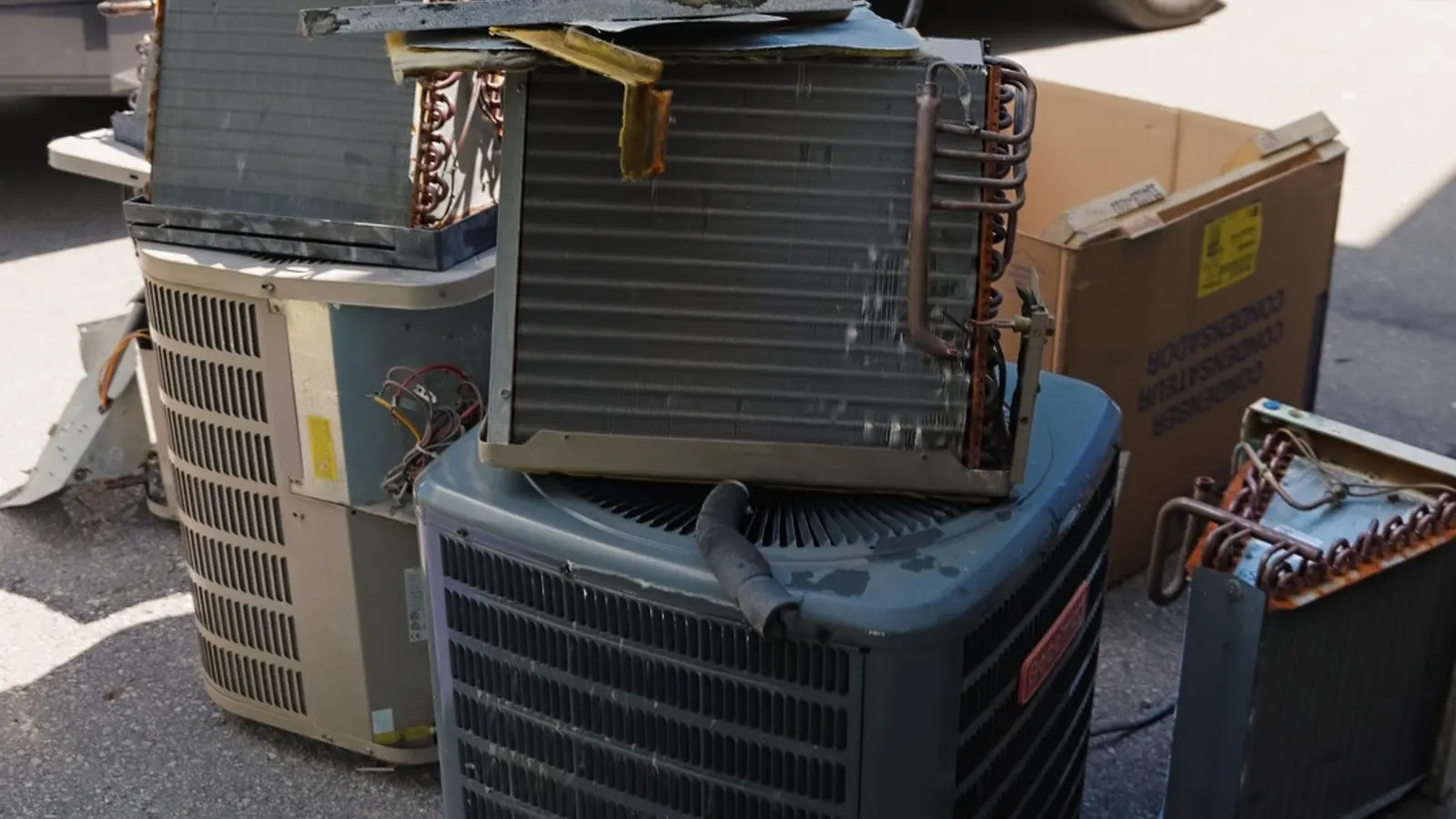
Grinding, squealing, or banging from the condenser unit usually means a failing compressor motor, worn bearings, or loose internal hardware. A healthy AC produces a steady hum and the rhythmic click of the compressor cycling. Any new mechanical sound deserves prompt diagnosis — compressor replacement alone costs $2,000–$3,500, which often makes full system replacement the better investment.
5. The System Uses R-22 Refrigerant
As noted above, R-22 is no longer manufactured in Canada. If your system needs a refrigerant top-up — which usually indicates a leak — you're paying premium prices for a diminishing supply. Any AC that uses R-22 is at least 10 years old, and the combination of refrigerant cost plus age makes replacement the clear financial choice in most cases.
Repair vs. Replace: The Cost Math
Use the 50% rule as a starting point: if a single repair costs more than 50% of a new system's price, replace. For the GTA market, a new mid-efficiency central AC (16 SEER2) installed runs $4,500–$6,500 depending on size and brand. That means any single repair over $2,250–$3,250 points toward replacement.
For a more nuanced view, multiply the repair cost by the system's age. If that number exceeds $5,000, replacement is usually more economical. Example: a $600 repair on a 12-year-old unit = $7,200 — replace. The same $600 repair on a 6-year-old unit = $3,600 — repair.
Factor in energy savings too. Upgrading from a 10 SEER system to a 16 SEER2 unit reduces cooling energy use by roughly 37%. For a typical GTA home spending $400–$600 on summer electricity, that's $150–$220 in annual savings — which compounds over the new unit's 15-year life.
What to Do Next
If two or more of these warning signs apply to your system, it's worth getting a professional assessment. A licensed technician can measure your system's actual operating efficiency, check refrigerant levels, and give you a clear repair-vs-replace recommendation based on your specific unit.
When you're ready to explore options, our guide to choosing the right AC covers system types, sizing, and what to look for in a quote. For sizing specifics, see what size air conditioner do I need.
Frequently Asked Questions
How much does a new central air conditioner cost in the GTA?
A new central AC installed in the Greater Toronto Area costs $4,500–$8,000 depending on size (tonnage), SEER2 rating, and brand. Premium brands like Lennox cost more; brands like Midea and KeepRite offer excellent performance at competitive prices. Installation typically accounts for 40–50% of the total cost.
Can I replace just the outdoor unit?
Technically yes, but it's rarely recommended. Mismatching a new condenser with an old evaporator coil reduces efficiency, voids most manufacturer warranties, and can cause premature compressor failure. If the indoor coil is more than 10 years old, replace both components together.
Is there a best time of year to replace an AC in Ontario?
Late fall and early spring (October–April) offer the best pricing and availability. HVAC contractors are less busy outside cooling season, so you'll typically see lower installation costs and faster scheduling. Avoid July and August — that's peak emergency replacement season with the longest wait times.
Are there rebates for replacing an old AC in Ontario?
Ontario's Enbridge Home Efficiency Rebate Plus program offers rebates for qualifying high-efficiency cooling equipment when combined with other energy upgrades. Rebate availability changes frequently — ask your installer about current programs at the time of your quote.
Don't Wait for a Breakdown
A failing air conditioner always picks the hottest day of summer to quit. If your system is showing warning signs, get ahead of the problem. Request a free assessment or call 1-855-539-4328 to speak with one of our licensed technicians.