The GTA Homeowner's
Air Conditioner Buyer's Guide.
AC types, SEER2 efficiency ratings, sizing, costs, and which brands are actually worth it.
How Does a Central Air Conditioner Work?
This GTA homeowner's air conditioner buyer's guide covers how central AC systems work, SEER2 ratings, the R-454B refrigerant transition, sizing, costs, and the brands worth installing in Toronto homes.
A central AC doesn't create cold air — it removes heat from indoor air using a refrigerant cycle. The indoor evaporator coil absorbs heat, the compressor pumps refrigerant to the outdoor condenser, and the heat is released outside.
Modern air conditioners use variable-speed compressors, ECM blower motors, and two-stage or inverter technology to deliver quieter, more efficient cooling. Today's best units achieve SEER2 ratings above 20, compared to 8-10 SEER for units from the '90s.
In the GTA's increasingly hot summers, a reliable air conditioner is essential. It runs 3-5 months a year, and choosing the right one affects your comfort, electricity bills, and home value for the next 15-20 years.
When Should You Replace Your Air Conditioner?
Not every AC problem means you need a new one. But there are clear signs it's time. Here's how we think about it as technicians:
- ✕ Over 12-15 years old
- ✕ Uses R-22 (Freon) refrigerant — phased out in Canada
- ✕ Compressor failure on an older unit
- ✕ Electricity bills rising despite maintenance
- ✕ 3+ repairs in the last 2 summers
- ✓ Under 8 years old
- ✓ First-time repair on a newer unit
- ✓ Simple fix — capacitor, contactor, or fan motor
- ✓ Repair cost is under 30% of replacement
- ✓ Uses R-410A refrigerant (still available)
Need help deciding? Book a diagnostic — our technicians will give you an honest recommendation, not a sales pitch.
AC Compressor Types Explained
Every central air conditioner works the same way — the difference is the compressor. The compressor type determines how efficiently your AC runs, how quiet it is, and how precisely it controls temperature.
Single-Stage
Runs at 100% capacity every time it turns on. Simple, reliable, and the most affordable option — but cycles on and off frequently.
- Lowest upfront cost
- Simple and proven technology
- Easy to repair
- Louder — full blast every cycle
- Temperature swings between cycles
Two-Stage
Runs at low speed most of the time, switching to high only on the hottest days. Quieter, more even temperatures, and better humidity control.
- Runs at low speed 80% of the time
- Much quieter than single-stage
- Better humidity removal
- More even temperatures throughout home
- Best balance of cost and comfort
Variable-Speed (Inverter)
Continuously adjusts output from 25% to 100% — like cruise control for your cooling. Whisper-quiet, maximum efficiency, and rock-steady temperatures.
- Near-silent operation
- Precise temperature control (±0.5°)
- Lowest electricity bills
- Superior humidity control
- Highest upfront investment
Our recommendation for most GTA homes: two-stage compressor, 16+ SEER2. Best bang for the buck. See our AC lineup →
The R-410A → R-454B Switch (Why It Matters Now)
As of January 1, 2025, all new residential central AC production in the US and Canada moved to lower-GWP A2L refrigerants — primarily R-454B (and R-32 on some ductless lines). R-410A — the refrigerant in virtually every system installed over the last 15+ years — is being phased out.
What this means if you're buying in 2026:
- Most new systems on the market are R-454B. R-410A inventory is still being installed from warehouse stock, but manufacturing stopped over a year ago. Expect R-410A refrigerant prices to climb as supply tightens — a repeat of what happened with R-22.
- A2L is mildly flammable (class A2L). Safe when installed correctly, but the install rules are stricter — charge limits, leak detection, brazing procedures. Your installer needs to be HRAI-certified and trained specifically on A2L handling.
- Don't replace a working R-410A system just for this. If your equipment is 8–12 years old and running fine, keep it. The transition matters at normal end-of-life (12–15+ years), not before.
- Matched coils and condensers. Mixing R-410A and R-454B components isn't allowed. If you're replacing just the outdoor unit on an older system, the indoor coil usually has to go too — factor this into any "just fix the compressor" quotes you're considering.
H&C is HRAI-certified and every tech on our trucks is trained and tooled for A2L refrigerants. We won't quote you an R-410A system in 2026 unless you specifically ask — the warranty and parts trajectory just isn't there anymore.
Getting the Right Size Air Conditioner
An oversized AC short-cycles (turns on and off too frequently), wastes electricity, and leaves your home humid and clammy. An undersized one can't keep up on the hottest days. Proper sizing matters more than brand.
Air conditioners are measured in tons of cooling capacity (1 ton = 12,000 BTU/hr). The right size depends on your home's square footage, insulation, windows, ceiling height, and sun exposure.
These are estimates only. A proper cooling load calculation considers insulation, windows, sun exposure, and occupancy.
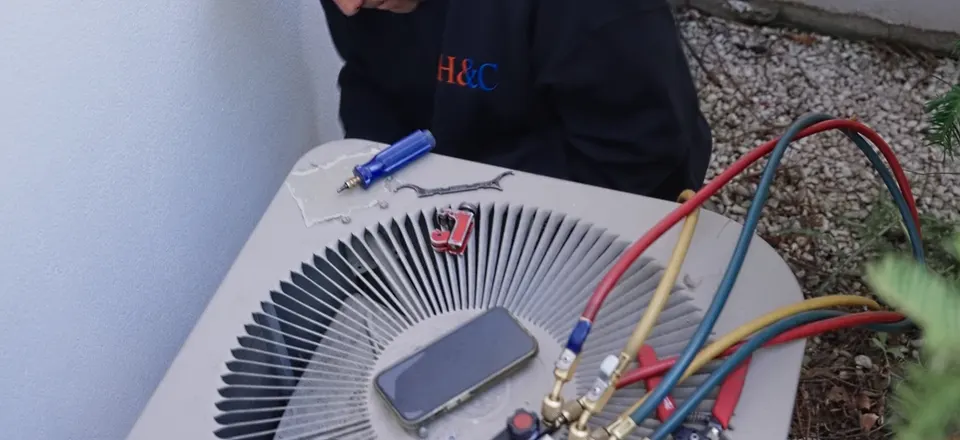
An oversized AC cools your home too quickly, then shuts off — only to turn on again minutes later. This "short cycling" wastes electricity, wears out the compressor faster, and leaves your home humid because the unit doesn't run long enough to dehumidify.
We do a proper cooling load calculation (Manual J) for every installation — not a guess based on square footage.
Understanding SEER2 Ratings
SEER2 (Seasonal Energy Efficiency Ratio 2) measures how efficiently your AC converts electricity into cooling over a full season. Higher is better — a 20 SEER2 unit uses roughly 30% less electricity than a 14 SEER2 unit for the same cooling.
As of January 2023, Canada adopted the SEER2 standard (replacing SEER) which uses more realistic testing conditions. Canada's minimum for new split-system central AC installations is 14.3 SEER2 (enforced by Natural Resources Canada, stricter than the US Northern-tier 13.4 SEER2 floor). Most quality units sold in the GTA today are 15-20+ SEER2.
GTA math: If you're replacing a 10 SEER unit with a 18 SEER2 unit, you'll use about 40% less electricity for cooling. On a typical $600-$900/summer cooling bill, that's roughly $250–$360/year in savings.
Honest Answer: There's No Real Rebate for a Straight AC in 2026.
Here's the truth no one else will tell you on their AC page: there is no meaningful government or utility rebate for a standalone central AC replacement in Ontario in 2026.
The Enbridge HER+ program closed to new applicants in February 2024. The federal Canada Greener Homes Grant wound down around the same time. Their replacement — Ontario's Home Renovation Savings Program (HRSP) — is heat-pump-focused, not AC-focused. A standalone AC doesn't qualify.
If you were about to replace your AC anyway, it's worth five minutes to consider a heat pump instead. A heat pump cools your home in summer (same job as an AC) and heats it in winter (replacing or assisting your furnace). Rebates:
- Cold-Climate Air-Source Heat Pump: up to $7,500 under HRSP for electric/oil/propane-heated homes; gas-heated homes get $500/ton, capped at $2,000.
- Ground-Source / Geothermal: up to $12,000.
- No energy audit required for single-measure heat pump upgrades.
- Program runs through November 2026.
We'll still sell and install you a straight AC if that's what you want — plenty of homes aren't the right fit for a heat pump, and that's fine. What we won't do is pretend there's government money that isn't there. If anyone is quoting you a "$5,000 Greener Homes rebate" on an AC install in 2026, they're either misinformed or hoping you are.
How Much Does a New Air Conditioner Cost?
The total cost of an AC installation includes the unit itself, labour, permits, and any electrical or ductwork modifications. Here's what GTA homeowners typically pay in 2026:
Financing available: We offer monthly payment plans through Financeit. Many GTA homeowners pay $60–$100/month for a new high-efficiency air conditioner — often offset by energy savings. Call for details.
Brand Comparison: Our Honest Take
We install and service every major AC brand. Here's what we've seen after 17+ years and thousands of installations:
We also service Daikin, Trane, York, and most other major brands — we just don't install them new, since we're already dealers for the brands above.
Every brand makes good and bad models. The brand matters less than: proper sizing, quality installation, and regular maintenance. See our recommended models →